The Potential
TAKE THE FUTURE READINESS ASSESSMENT
Benchmark your leadership readiness in the AI era with our free Future Readiness Assessment.
Develop Quantum Leadership in the AI & Robotics Era
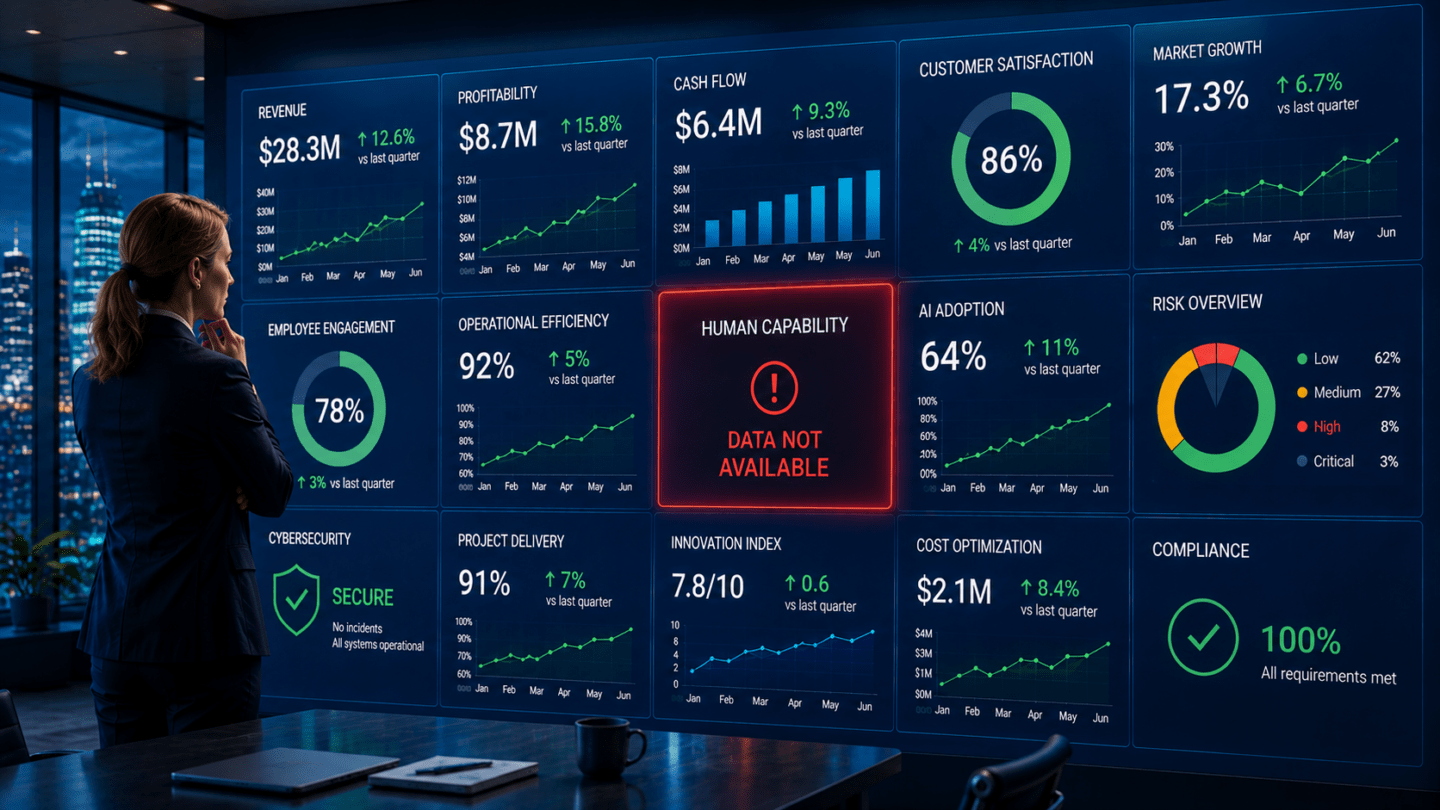
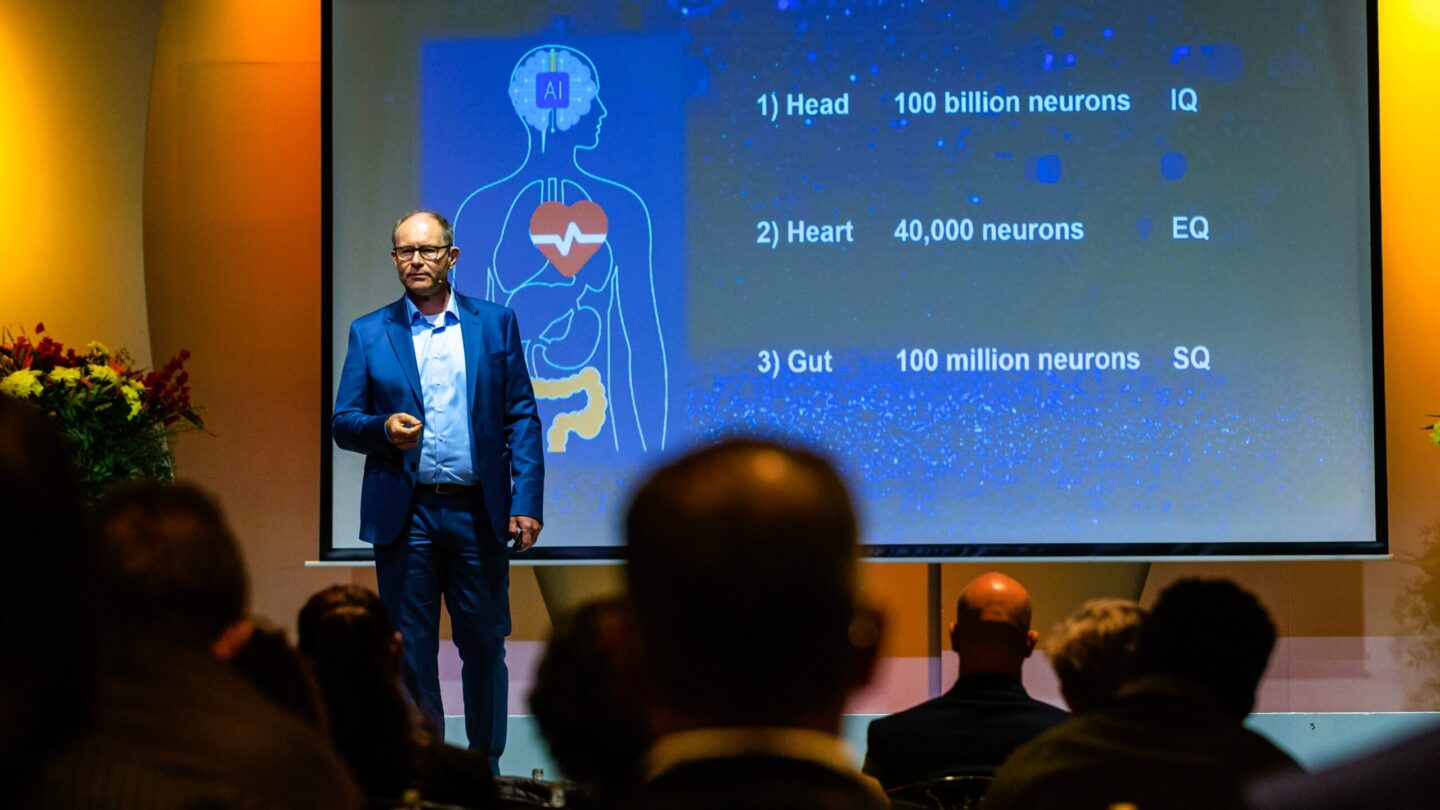
As AI transforms how we think and work, a deeper question emerges: who are you as a leader when thinking is no longer your edge? What will leadership look like in the AI era? What remains uniquely human? Which skills will help you thrive and how can you prepare? The future of work is not just technological – it’s deeply human. Join our Conscious Leaders Community and shape what comes next, together!
Rethinking Value Creation with AI
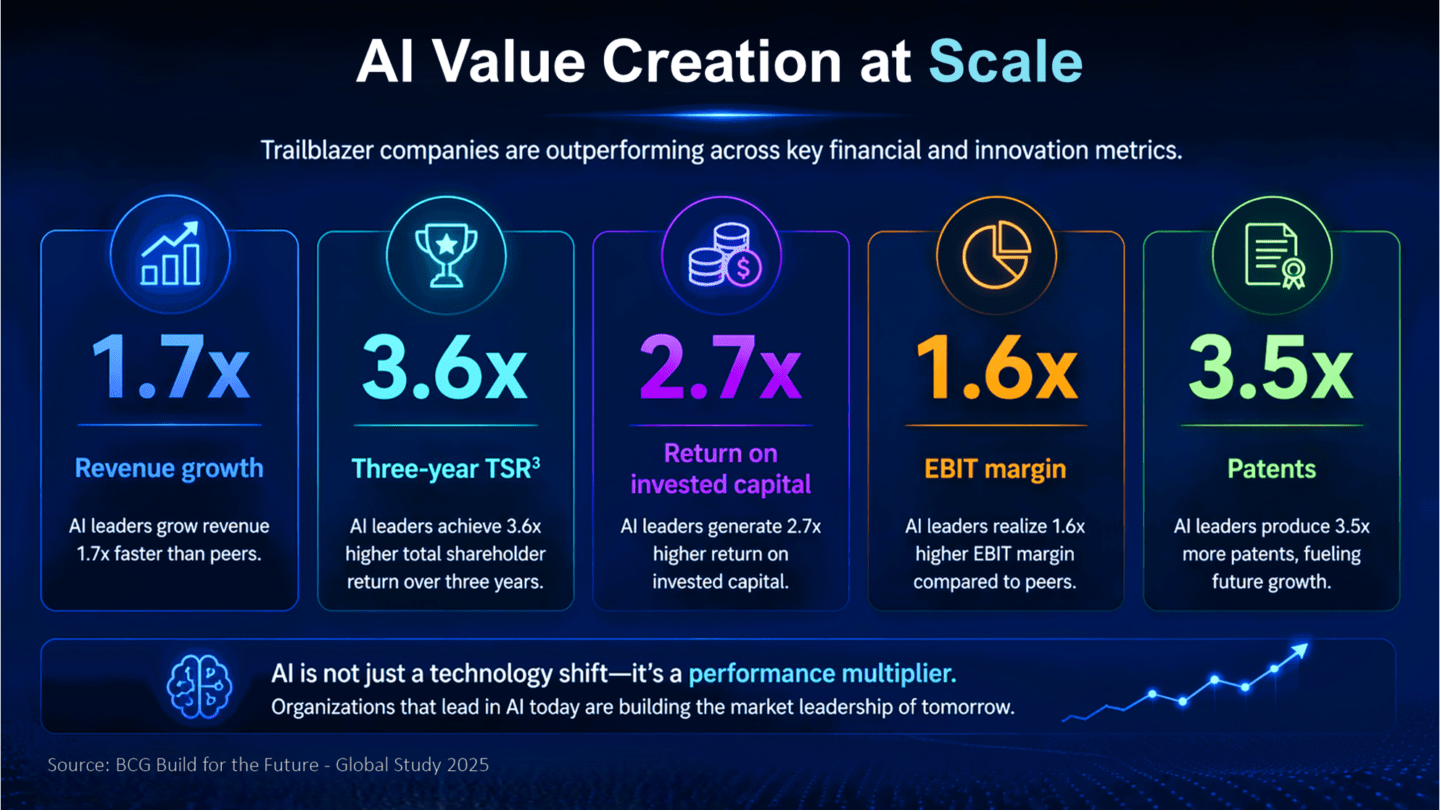
AI could contribute trillions to the global economy by 2030 (McKinsey, PwC, Goldman Sachs). Top performers move beyond efficiency, creating new revenue streams with AI-enabled business models. Productivity doesn’t just improve, it compounds when workflows are redesigned and people are upskilled. Innovation cycles accelerate, turning speed into a competitive edge. The strongest EBIT impact comes not from headcount reduction, but from reinventing business and operating models and speeding up decision-making.
From AI Hype to Reality Gap
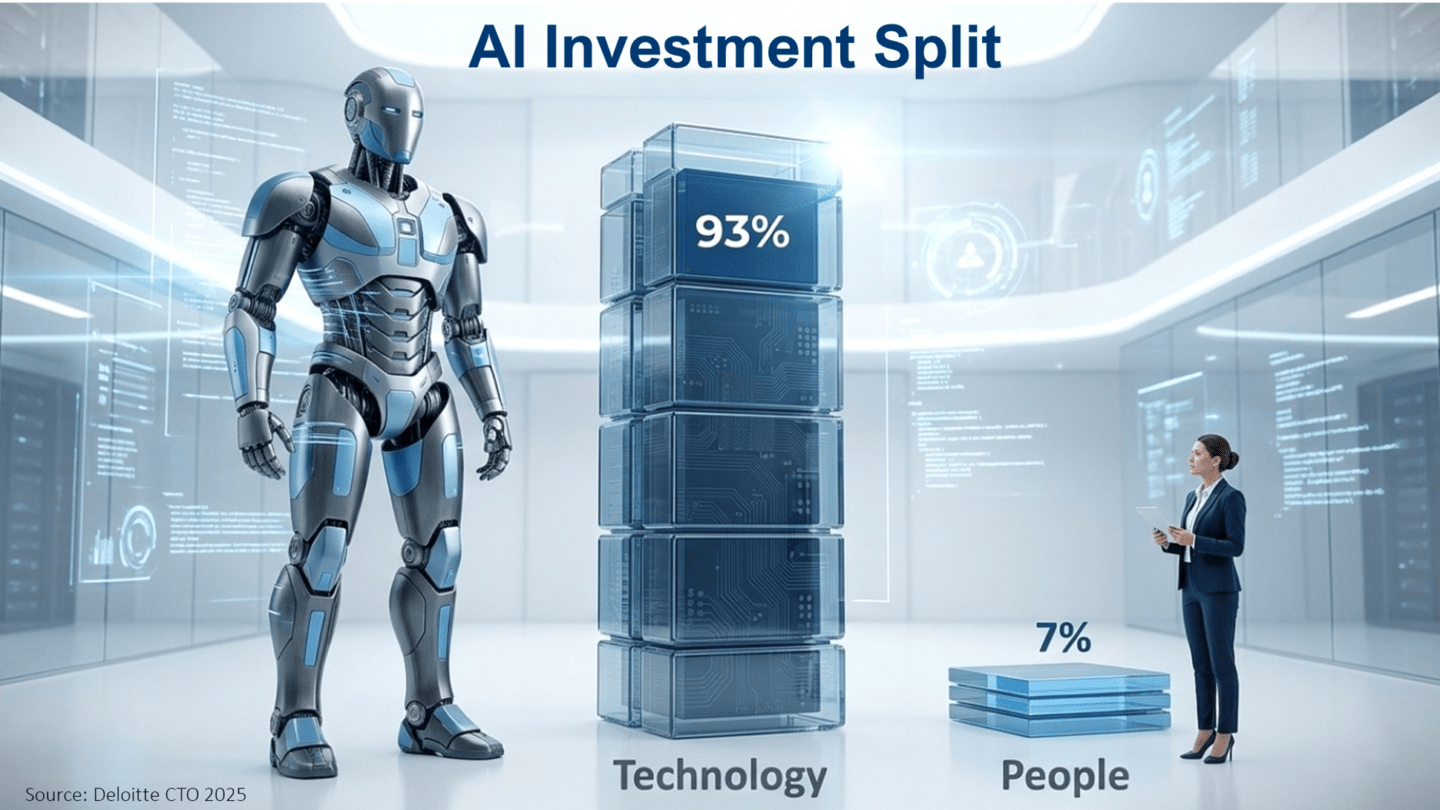
AI investment is rising, but results lag behind expectations. The core issue isn’t technology – it’s people. Over 60% of implementation challenges trace back to human factors (Prisco, BCG), yet most organizations remain fixated on tools and use cases. Training teaches prompting, but ignores what actually drives adoption: psychological safety, sound judgment, and the right innovation culture. The result is shallow uptake and unrealized value. Closing the gap requires people to rethink their role and identity, build genuine confidence, and learn to decide and create alongside non-human intelligence – as true partners in hybrid teams.
The Human-Centered AI Playbook
AI succeeds when treated as a cultural and behavioral transformation – starting with people. Leading companies frame AI as augmented intelligence, not a threat, and build human-centric capabilities that drive growth and innovation. They align leadership, combine centralized vision with decentralized execution, and share ownership across business and IT. At the same time, they address real concerns: Will I stay relevant? Can I keep up? How do I work with an AI teammate? By co-creating answers, scaling upskilling, and enabling strong platforms, they turn fear into capability—and strategy into results.
Human Readiness for the AI Age
Frequently Asked Questions – These are the questions that matter most to the people we talk to. We will answer them the best way we know how – honestly, and without pretending to have all the answers.
Why do 80 to 95% of AI transformation projects fail, and what is the real reason nobody talks about?
Research consistently shows that AI programs collapse not because of the algorithm, but because of the human layer: teams unprepared to experiment, leaders who skip the change management work, and cultures where fear of failure is stronger than the appetite for learning.
In many enterprises across Germany, the US, and South Africa, the pattern is the same: organizations invest heavily in tools and almost nothing in people readiness. The result is expensive software that goes unused and teams that quietly disengage.
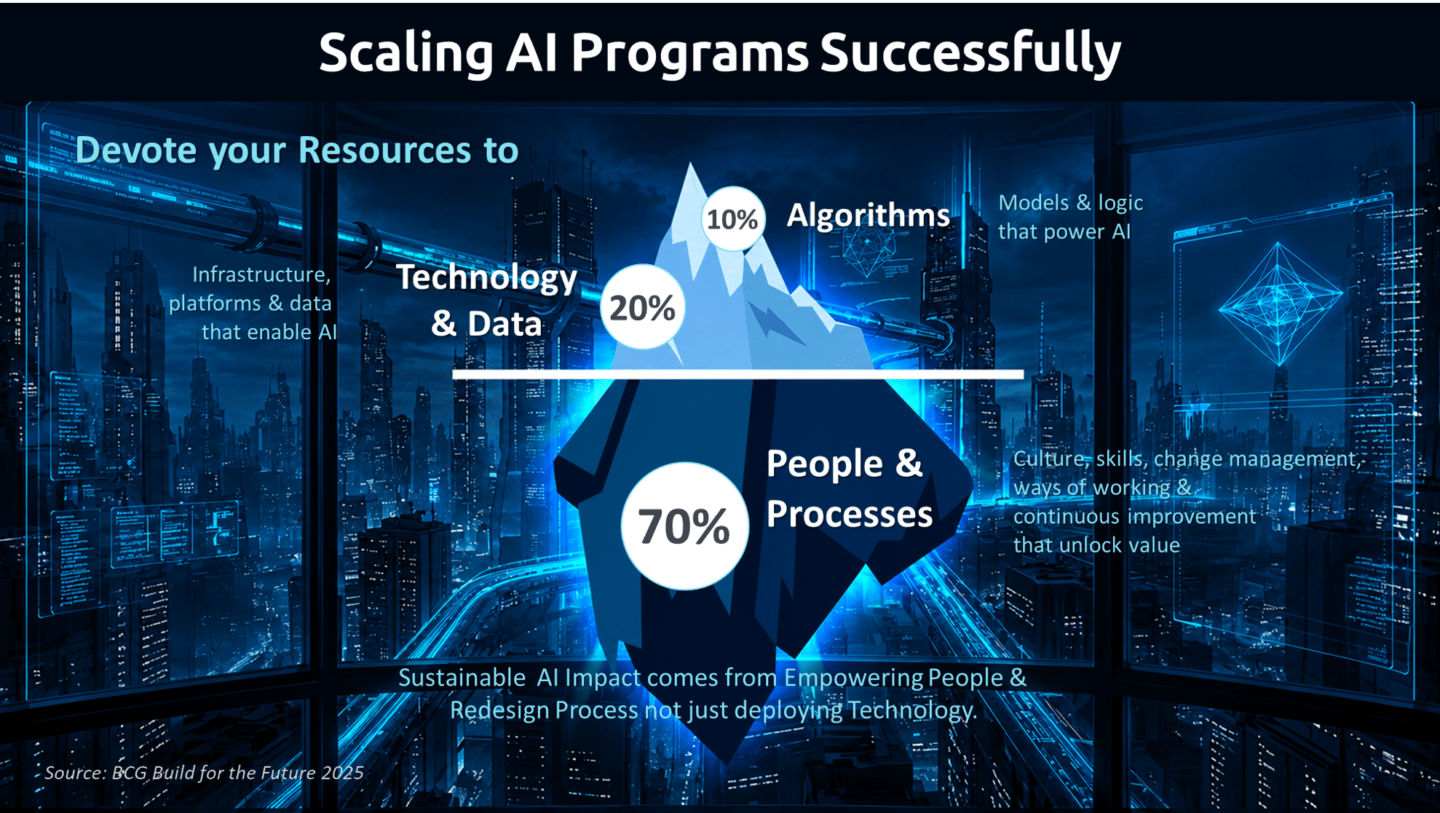
What is the 70-20-10 rule for AI, and why does it matter for how you allocate resources?
The BCG 70-20-10 framework is based on where AI programs actually succeed or fail. The technology component (10%) is the easiest to buy. The hard work is building people readiness: AI literacy at every level, psychological safety to experiment, and leaders who can manage the disruption that comes with role changes.
For a mid-size company, the stakes of getting this wrong are immediate. When an experienced employee sees AI changing her role, she does not experience it as digital progress. She experiences it as an identity threat. That requires deliberate leadership attention, not a software rollout.
How do I choose the right, first AI use case for my company?
The right first use case meets three criteria: high repetition (your team does it weekly in a similar way), low risk if the output is wrong (a human reviews it before it reaches a customer), and visible benefit to the person doing the work, not just to the business bottom line. Offer preparation, standard customer responses, and internal documentation are typical starting points.
The most common mistake is starting with the most strategically important process. That carries too much risk and too much pressure for a first experiment. A smaller, unglamorous use case builds the experimentation muscle the organization needs before tackling anything complex.
What does an experimentation culture mean in practice, and why is it critical for AI adoption?
An experimentation culture is defined by one specific behavior: the willingness to try something, fail visibly, and share what was learned. In the context of AI, this means distinguishing between reversible decisions (a marketing draft reviewed before sending) and irreversible ones (AI used in hiring decisions). Teams need structural permission to experiment in the first category without fear of judgment.
The simplest tool is a 15-minute weekly ritual: what did we try with AI, what worked, and what did not? Without this structure, the same mistakes repeat and nothing accumulates. The leader’s role is to model this first. In any company, if the leader does not share their own AI failures openly, no one else will.
How does psychological safety affect AI adoption in companies?
AI creates two specific anxieties that traditional change management does not address. Employees who use AI worry: “Will people think I cannot do this myself?” Employees who do not use it worry: “Will asking how it works expose me as someone falling behind?” Both reactions are invisible to most leaders and both shut down the experimentation needed for adoption to succeed.
The identity threat is sharpest for experienced employees. A finance manager with 20 years of expertise who sees AI drafting her reports in seconds is not thinking about efficiency. She is asking what her value is now. Teams where this question goes unaddressed develop quiet resistance, disengagement, and eventually turnover among the very people whose judgment is needed to oversee AI output.
What leadership skills matter most for AI transformation?
Technical AI knowledge is not the critical skill. It can be delegated. The four capabilities that cannot be delegated are: radical prioritization (committing to one use case for six months and resisting the pull of every new tool); visible learning (experimenting yourself and sharing what failed); trust-building under uncertainty (answering “what does this mean for me?” honestly, including when the answer is unknown); and deciding without full evidence (moving forward transparently rather than pretending certainty).
These play out differently by market. German Mittelstand leaders often need to shift from operational to strategic thinking. US mid-market leaders tend to move fast but underinvest in the psychological infrastructure for sustained adoption. In South Africa, the opportunity is to build the right culture from the start rather than inheriting legacy organizational habits.
Start Your AI Journey...

Psychological Safety: Powering Performance and AI
From Holding Back to Thriving Together
Online & in-person


Master the Art of Sovereign Decisions
Find clarity as an augmented leader in the AI era
Online


Artificial Intellect & Conscious Intelligence
Thought-provoking insights about thriving in the age of artificial intelligence
Online
Free

How to Future-Proof Your Organisation
Navigate Complex Challenges and Build Adaptive Organizations
Online
Free

Navigating Change, Disruption & Progress
Lead with Insight: Mastering the Human Dynamics of Transformation
Online
Free


Leading Tomorrow
How to Prepare Leaders for What’s Next
Online
Free