
The theme of the first article on Conflict was entitled, Conflict: Humanity’s Best Friend. It ended with the comment, …”if conflict is so pervasive across every dimension of human experience, perhaps we have misunderstood its role in our lives. Perhaps conflict is not an aberration to be eliminated but a fundamental feature of the human condition.”
The purpose of the second article, The Gifts of Conflict, is to see what happens when we actually look forward to our next conflict as suggested below.
Three Gifts of Conflict
Imagine if Conflict would not be something to be avoided, but embraced with enthusiasm.
Here are three reasons to welcome our next conflict.
- When we welcome anything, we are already in the proper state to function effectively.
- Since the essence of true leadership is relationship, meaning people trusting us and believing we care about them, it is through conflict that trust and care are deepened.
- To be skilled in conflict means being interested in listening. That alone will transform our relationships.
Preparing for Our Next Conflict
First, ask yourself, are you actually interested enough in your development as a leader to be excited about changing those habits that no longer serve you when conflicts arise?
Our genuine interest is the first step, isn’t it? When we are interested, listening is natural!
Second, ask yourself, do relationships really matter to you?
It matters that we care about relationships, doesn’t it? People can always tell if we sincerely care.
Third, are you willing to listen to yourself, to your own inner life, as well as to what matters to others in moments of conflict?
Four Levels of Listening
According to Otto Shermer as summarized by chatgGPT, there are four levels of listening.
1. Downloading (Listening from Habit)
“I already know this.”
- We hear only what confirms what we already believe.
- Past experiences, opinions, and judgments dominate.
- No real openness—just replaying old mental tapes.
Most everyday conversations live here, because we do not really like to leave our comfort zone.
2. Factual Listening (Listening from the Mind)
“What’s actually new or different here?”
- Attention shifts to facts and data.
- We notice contradictions, surprises, and evidence.
- The listener becomes curious rather than defensive.
This is where learning begins.
3. Empathic Listening (Listening from the Heart)
“How does this person experience the world?”
- We listen from the other person’s point of view.
- Emotions, tone, and meaning matter as much as words.
- A real human connection forms.
This is where trust and understanding emerge.
4. Generative Listening (Listening from the Emerging Future)
“What is trying to be born here?”
- Deep presence and silence are part of the listening.
- The listener lets go of old identities and assumptions.
- New insights, possibilities, and actions arise – not forced.
This is where transformation and creativity happen.
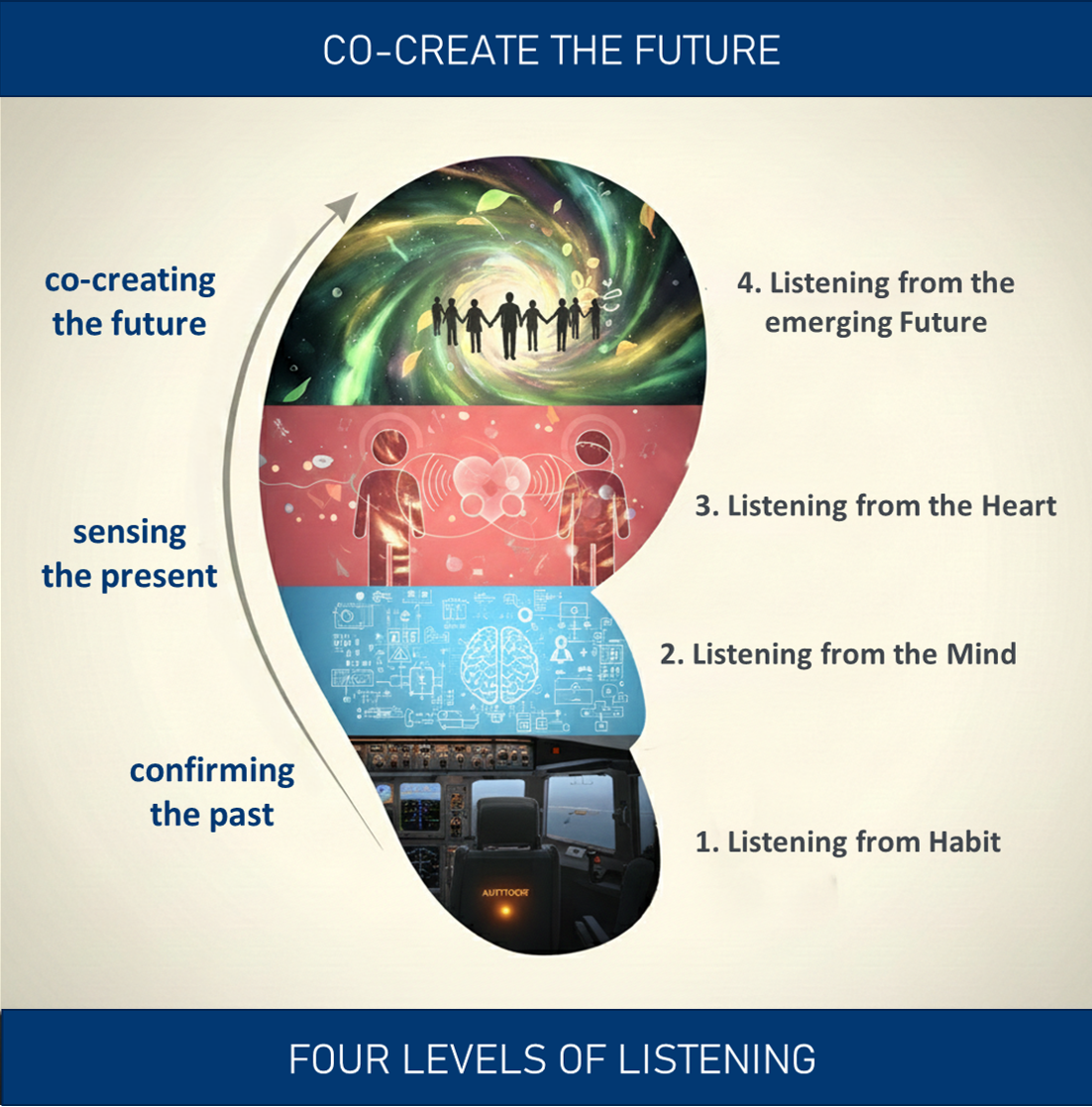
In one sentence
As you move through the levels, listening shifts
from confirming the past → sensing the present → co-creating the future.
As a leader you always need to collaborate to achieve your goals in the future.
Listening is a Matter of Interest
Finally, notice these levels of listening are not foreign to us. At our best, we have had moments when we have functioned at levels two, three and even four.
Recall a time when words and actions arose in us exactly when they were needed.
Stop reading further and remember this kind of moment in your life.
These were times when we connected. Times when we experience the best in each other; times when we helped someone see something that they had not yet recognized in themselves.
Is there anything more satisfying than these moments when we really listened, listened to what was arising in ourselves and what mattered to another.
Handled well, such moments are some of the most beautiful expressions of our Integrity, aren’t they?